


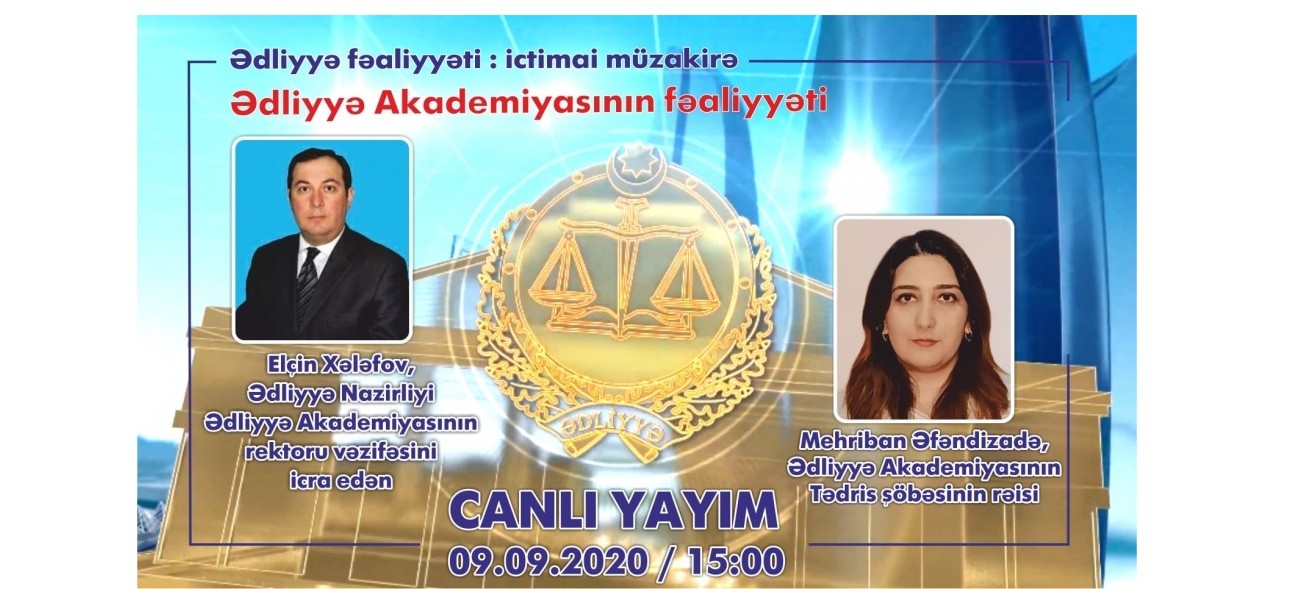
Baku, September 9, AZERTAC
In order to ensure the access of citizens to the judiciary, to inform them regularly about the activities of the judiciary, the work of wide use of opportunities of both of civil society representatives and the media, as well as the official websites and social networks of the Ministry of Justice is continued.From this point of view, the live broadcast of various activities of the judiciary on the Ministry's official Facebook page during the special quarantine regime in the implementation of the President's instructions also plays an important role in legal education of the population.
AZERTAC reports that as part of the next measures taken in this direction, on September 9, the Ministry of Justice held an online public discussion on "Activities of the Academy of Justice."
Acting rector of the Academy of Justice Elchin Khalafov and head of the education department of the Academy Mehriban Afandizada, who took part in the public discussion, informed about the main activities of the Academy.
It was noted that, the Academy of Justice was established within the structure of the Ministry of Justice by the Decree of the President of the Republic of Azerbaijan dated August 17, 2006 "On the development of the judiciary." The Charter of the Academy of Justice was approved by the Decree dated November 21, 2008. The main purpose of the Academy of Justice is to train qualified personnel for the judiciary, prosecutor's office and justice authorities, to provide legal training for justice workers without higher legal education, to study conceptual problems for the development of the judiciary and advocacy, to conduct fundamental and applied scientific researches on various fields of law. It was reported that the Academy of Justice was active during the pandemic. The activity was mainly remote. In addition, graduation, advanced training and courses were organized.With the launch of the event in September, the Academy will further expand its activities in this area. The Academy of Justice has a relevant faculty for each specialty. Every year about five thousand students are involved in these courses at the Academy. The Academy closely cooperates with governmental and non-governmental structures.Candidates for membership in the judiciary, prosecutor's office, bodies, bar association, as well as candidates for judges are involved in the initial specialization courses held at the Academy.The curricula of the compulsory training implemented at the Academy of Justice are agreed by the representatives of the relevant bodies and discussed by the Scientific Council of the Academy.In order to include necessary and practical topics in the curricula, the Scientific Council includes representatives of relevant bodies.Taking into account different opinions, as well as conducting and considering surveys among participants about the quality of programs, makes them more complete and useful for practical activities.
It was noted that the courses taught at the Academy differ from the topics taught at the Faculty of Law in their practical significance. Practitioners - judges, prosecutors, lawyers - are involved in the training as trainers.Judges, lawyers, and prosecutors, who are mainly involved in training on a voluntary basis, are taught pedagogical skills in training courses. The opportunities of law teachers are also widely used. The main training base is the practical staff.
It was noted that the study of international experience in the organization of advanced training is very important for the Academy. The activities of foreign Justice Academies with extensive experience in this field and their curricula are studied.In this regard, a number of projects of the Council of Europe and the European Union to increase the capacity of the Academy have been implemented. Within the framework of these projects, the projects to improve existing programs and train trainers have been implemented and this experience has been used.In 2019, Azerbaijan ranked 10th among 47 member states of the Council of Europe in terms of the number of users within the project to study the case law of the European Convention on Human Rights. Judges and lawyers are especially interested in studying this convention.In addition, in order to strengthen the partnership with international organizations, cooperation with foreign academies, joint trainings and video conferences were held at the Academy within the framework of agreements signed with various countries.
It was noted that e-learning at the Academy became actual during the pandemic. There must be appropriate equipment for e-learning, which is a type of distance learning. The Academy of Justice has been preparing for this activity for a long time, and first of all, its website has been updated, and relevant programs available in the Azerbaijani language have been posted.There is a separate section on the case law of the European Convention on Human Rights on the site. The information posted on the site is widely used by judges, prosecutors, lawyers and justice officials. The e-learning platform of the academy has also been created with the help of the International Organization for Migration.The purpose of the platform is to computerize the teaching process and ensure the accessibility of training materials to the audience. There are video lessons on various topics on the platform, and they are free. In this context, during the pandemic, more than 500 students were remotely involved in compulsory and advanced training courses.
It was noted that the "Legal Support" department of the Academy of Justice provides free legal assistance. Citizens' appeals included in this section and the Academy's assistance in resolving them are of great importance. Thus, on the one hand, the Academy enriches theoretical knowledge with experience, on the other hand, it provides useful legal assistance to the socially vulnerable layer and demonstrates useful activities for society.Currently, the Academy, together with the Bar Association, provides free legal assistance to the population with the involvement of law students within a project implemented by the Council of Europe. Since 2013, 3,000 citizens have been provided with free legal aid. This year, legal assistance was provided to 200 people, including remotely.
It was stressed in the online public discussion that, the Academy of Justice will continue to work in the field of implementation and education of judicial and legal reforms in the country, as well as touched upon other issues of interest and answered questions from social network users.


