


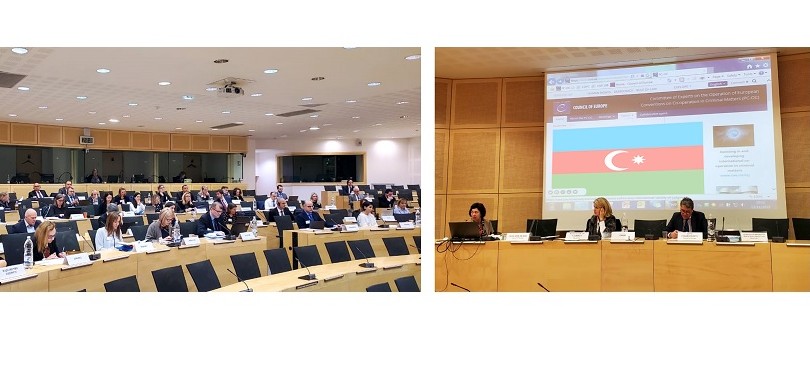
The 77th plenary session of the Committee of Experts (PC-OC) of the Council of Europe on the implementation of the European Convention on Co-operation in Criminal Matters (extradition, legal aid on criminal cases, etc.) was held on November 13-15 in Strasbourg.
Adil Abilov, the chief of the International Cooperation Office of the Ministry of Justice, as the competent authority of Azerbaijan participated in the plenary session, which was attended by the Council of Europe member states, other states joining these conventions and the officials of the Council of Europe.
In the event there were discussed the matters of extradition, mutual legal aid on criminal cases and current practice in extradition, drafting inquiries on extradition, updating of the Extradition Standards Guide published by the Council of Europe, as well as new cases in this field considered by the European Court of Human Rights.
Speaking at the meeting, the Azerbaijani representative informed about the works made in the field of legal assistance and extradition by the Ministry of Justice, conclusion of bilateral agreements with other countries and noted that, the Fourth Additional Protocol to the 1957 European Convention on Extradition was signed by Azerbaijan last month. He said that, the protocol was signed by the Minister of Justice Fikrat Mammadov on behalf of our state with the participation of the Secretary General of the Council of Europe in Strasbourg.
The contribution of our country in updating the extradition standards guide has been appreciated by the Council of Europe. In addition, a model extradition inquiry has been approved with consideration of proposals from the Azerbaijani side.
A special session on the 60th Anniversary of the European Convention on Legal Aid for Criminal Affairs was held within the framework of the Committee's meeting.
The representative of Azerbaijan, selected by PC-OC as a rapporteur on providing international legal aid via video conferencing, spoke about the history of video conferencing in international legal aid in criminal cases and said that, the first such method was used in Italy to ensure security at the end of the last century in cases regarding mafia.
Referring to international practice, decisions of the European Court, it was emphasized that, the provision of international legal aid through criminal video-conferencing served to eliminate the need for transportation of prisoners and to ensure the security of vulnerable groups, especially children, to save money and to
decrease time loss, and to conduct more effective and comprehensive judicial proceedings and interrogations.
At the same time, practical measures taken in our country in this area, legislative renewal, promotion of projects, pilot use of video conferences in some courts have already been discussed.
During the event, representatives of a number of countries exchanged useful views on extradition issues.


